The Ordinary-Room Test: Nine Small Ways to Look at a Diamond Differently
A diamond can be very convincing beneath a jewellery counter’s lights. It flashes, you tilt your hand, and suddenly every sensible question seems rather dull. Then you take it into an ordinary room. The fireworks settle down. The stone becomes something quieter, and the interesting part begins.
Our last article collected fifty lessons about looking at diamonds. This time, let’s try a smaller experiment: nine ways to look at one without turning the afternoon into a gemology examination. Think of it as a little field guide for the kitchen table, the window seat, and the unglamorous corridor outside the showroom.
The point is not to catch a diamond misbehaving. Every stone changes with its surroundings. The point is to discover which version you enjoy living with. A ring will spend far more time beside coffee cups and computer keyboards than beneath a spotlight.
1. Start with the least impressive room
Choose somewhere pleasantly ordinary. A living room with indirect daylight is useful; a room with several competing lamps is less useful for a first look. Put away the magnifier. Hold the ring at the distance at which you would normally notice someone’s hand.
Ask a simple question: does the whole thing look appealing? You might notice the outline, the balance between stone and band, or a pattern of bright and dark facets. None of those observations needs a technical name to matter.
Give your eyes a minute. The first glance often searches for the spectacular. The second begins to notice character. A diamond does not need to deliver a tiny light show every second to remain beautiful.
2. Give the window a turn
Move near a window without putting the ring in a beam of direct sun. Turn your hand gently, then pause. Compare that impression with the view from farther inside the room. You are changing the light, not asking the diamond to pass a universal brightness test.
GIA’s explanation of how lighting affects diamond appearance is a helpful starting point: different lighting environments reveal different aspects of a stone. That is why one flattering photograph cannot describe its entire personality.
Try not to turn this into a contest between “good” daylight and “bad” artificial light. Both can tell you something. The useful discovery is whether you like the ring across several settings, rather than only in the one that flatters it most.

3. Watch the pauses between the flashes
We tend to describe diamonds with energetic words: sparkle, dazzle, glitter. Yet the quieter intervals are worth watching. When the hand stops, do you enjoy the arrangement of light and shade? When it moves again, does the pattern change in a way you find attractive?
A permanently white-looking photograph can hide as much as it reveals. Contrast is part of the visual experience. A dark reflection is not, by itself, proof of a poor diamond; your head, camera, clothing, and surroundings can all influence what you see.
GIA distinguishes brightness, fire, and scintillation in its guide to diamond quality factors. You do not have to memorize the vocabulary. Just resist treating every kind of sparkle as the same thing, or expecting every lighting condition to produce all of it at once.
4. Make the hand do something boring
Rest it beside a mug. Hold a book. Lay it loosely on a table. These are surprisingly useful viewing positions because they interrupt the showroom habit of presenting a ring as though it were on a velvet stage.
Notice how much of the setting you see from your own angle. A high centre stone might look wonderfully sculptural. A lower setting might feel visually calmer. A wide band might give the diamond a satisfying frame, or simply be more metal than you prefer.
This is a looking exercise, not a stress test. There is no need to knock the ring against anything, tug at the stone, or wear it through chores. Ordinary gestures provide enough information without inventing an obstacle course for jewellery.
5. Look sideways before looking closer
The top-down view gets nearly all the publicity. The side view often explains why two similar rings feel completely different. Look at the space beneath the stone, the curve of the shoulders, and the way the setting rises from the band.
Does the profile feel like one coherent design? Or does the diamond appear to have been parked on top of something unrelated? That is a matter of taste, but it is a useful question to ask before the specification sheet takes over the conversation.
Also consider how the ring might sit beside a wedding band. Ask the jeweller about fit rather than assuming two attractive rings will automatically make an attractive pair. A tiny gap can be charming; an unexpected awkwardness is less charming when discovered later.
6. Let the phone be a notebook, not a judge
Take one photograph in the window light and one in the room’s usual lighting. Keep the distance and angle reasonably similar. Avoid beauty filters, sparkle effects, and dramatic exposure changes. The purpose is to remember your impressions, not produce an advertisement.
Then compare the screen with the actual ring. Phones make decisions about exposure, colour, sharpening, and focus. Sometimes the camera makes a stone look flat. Sometimes it makes a modest flash look heroic. Neither result deserves the final vote.
If you are comparing retailer videos, ask whether the backgrounds, magnification, and lighting are comparable. Two polished clips may be enjoyable to watch while offering a rather unfair comparison. A plain additional video can be more useful than another cinematic close-up.
7. Change the background, gently
A pale tabletop, a dark sleeve, and your own skin can make the same ring feel different. Try a couple of neutral surroundings. Keep the lighting steady while you do it, otherwise you will not know which change produced the new impression.
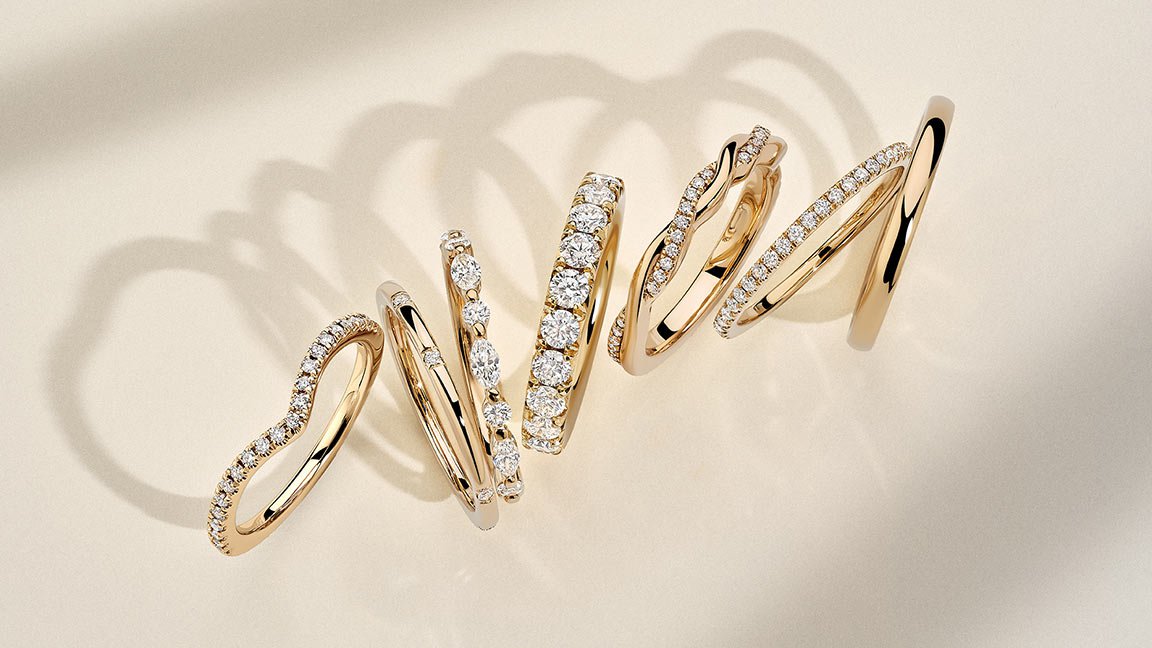
This is particularly interesting with warm metals. Yellow gold creates a different visual frame from white metal, and the eye reads the whole arrangement. That does not allow you to diagnose a diamond’s colour grade at home. It does let you decide whether you enjoy the combination.
There is no prize for choosing the background that makes the stone appear whitest. You are looking for a ring that feels convincing on an actual hand. The nicest version may be the one that looks comfortable rather than exceptionally icy.
8. Write three observations without using “sparkly”
This sounds faintly ridiculous until you try it. “Sparkly” is convenient, but it can swallow every other impression. Describe three things you noticed without using that word, a carat figure, or a clarity grade.
Perhaps the stone looks crisp from across the table. Perhaps the setting feels too tall when seen from the side. Perhaps the band makes the centre diamond look beautifully contained. Those notes are more useful than a page of enthusiastic adjectives.
If you are comparing two rings, write the notes before checking their prices again. It will not make you immune to expectations, but it creates a small pause between what you saw and what you think you ought to prefer. That pause can be valuable.
One other note belongs in that little notebook: where you were standing. “Liked it by the north-facing window” is a more honest memory than “looked amazing everywhere.” If you revisit the ring another day, those small details help you compare like with like. You may discover that what you loved was a broad flash, a delicate outline, or the warmth of the metal against your skin. Specific preferences make shopping easier. They also give you permission to disagree with the person beside you, who may be looking for something entirely different.
9. Stop before the inspection becomes the hobby
There is a point at which looking more produces less certainty. You have checked the report, asked the practical questions, understood the return terms, and viewed the ring in sensible conditions. Now you are examining the same reflection for the seventeenth time.
Take a break. A diamond is allowed to be an object you enjoy rather than a puzzle you solve completely. If a particular concern remains, put it into a clear question for the jeweller or an independent professional. Repeatedly zooming into an ambiguous phone photograph rarely supplies a satisfying answer.
Our favourite outcome of the ordinary-room test is pleasantly undramatic: you glance down during an otherwise forgettable afternoon and like what you see. The ring makes sense on your hand. The setting has a shape you enjoy. The diamond has something to say even when the lighting is not making a speech.
That is a useful kind of confidence. It comes from paying attention to everyday appearances, while letting proper documentation and professional advice do their separate jobs. The extraordinary little stone still belongs in an ordinary life.…